 How-to
Kung Fu Training for Resilience: A Practical Child-Friendly Plan
Last Updated: November 22, 2026
Quick Summary
Kung fu training for resilience builds mental toughness by asking students to stay calm while their body works hard. Each class pushes slightly past comfort, then allows a short rest, so the mind learns to stay steady under strain over months.
- Kung fu trains the mind to stay with a task when the body wants to quit.
- Recommended beginner training is two to three days a week for 30 to 45 minutes per session.
- Move to the next phase only after two consecutive sessions meet the progression check.
- Stop any drill that causes sharp pain, dizziness, or breath-holding, and never use holding a stance until tears as motivation.
- Track consistency, recovery after setbacks, focus during practice, and perceived stress rather than using a clinical test.
Table of Contents
- How Kung Fu Builds Mental Resilience
- Kung Fu for Children's Focus and Discipline
- A Progressive Resilience Training Plan
- Martial Arts and Emotional Regulation for Kids
- Kung Fu Perseverance Exercises for Children
- Building a Martial Arts Practice Routine for Kids
- Booking Your Child's or Your Own First Class at Dragon Claw Academy
- Frequently Asked Questions
How Kung Fu Builds Mental Resilience
Kung fu training for resilience builds mental toughness by asking students to stay calm while their body is working hard. Each class pushes a little past comfort, then gives a short rest. Over months, that pattern teaches the mind to stay steady under strain.
At Dragon Claw Academy, we teach traditional Kung Fu in Flower Mound, where small, repeated challenges add up over time. Students learn that discomfort is temporary and that effort produces visible progress.
The Link Between Martial Arts and Mental Fortitude
Mental fortitude is the ability to keep working when a task feels hard. Kung fu trains it in a practical way.
The lesson is simple. The mind gives up before the body does.
Watch out: pushing a student to hold a position until they cry or lose control teaches fear, not resilience. Good instructors stop the drill before that point.
[VIDEO PLACEHOLDER: Instructor demonstrating a basic horse stance with a student copying the posture]
Kung Fu for Children's Focus and Discipline
Kung fu for children's focus and discipline works because every class has a clear structure. Students bow in, warm up, practice a set sequence, and bow out.
Students must wait their turn, follow counts, and watch the instructor closely, which are habits that can support focus in other settings.
Discipline grows from repetition. A child who practices the same form each week learns to care about details, such as foot placement and hand position.
A Progressive Resilience Training Plan
Most articles on kung fu and resilience describe benefits. This plan gives you a sequence you can actually follow. It is built for a beginner training two or three days a week for 30 to 45 minutes per session, with at least one rest day between harder sessions. Move to the next phase only when you can complete the current phase with steady breath and controlled posture on two consecutive sessions.
Phase 1: Foundations and Breath (Weeks 1-3)
The goal is to teach your body and mind that effort and calm can coexist.
- Belly breathing: 2 minutes at the start and end of every session. Place one hand on your lower ribs and feel the ribs expand sideways rather than the shoulders lifting.
- Horse stance hold: 30 seconds, then 30 seconds of rest, for 5 rounds. Keep the knees tracking over the toes and the spine tall.
- Slow form walk: Step through a short form at half speed for 3 minutes, pausing for one breath at each transition.
- Calm reset drill: At the end of each round, pause, take one slow breath in and out, and notice whether your shoulders are tense.
Progression check: you can hold the horse stance for 30 seconds without holding your breath or letting your knees collapse inward.
Phase 2: Stances, Forms and Repetition (Weeks 4-8)
Repetition is where resilience becomes physical. The discomfort of a long set teaches you to keep your attention on the task instead of the clock.
- Form repetition: Perform one short form three times with full focus, resting 60 seconds between sets. Add a fourth set in week 6 if the first three stay clean.
- Stance ladder: Hold horse stance 40 seconds, bow stance 30 seconds per side, and cat stance 20 seconds per side, resting 20 seconds between stances.
- Counted movement: Count each movement out loud during one form pass. The counting occupies the part of the mind that wants to quit.
- Recovery habit: Finish every session with 3 minutes of slow walking and 2 minutes of belly breathing. Sleep and hydration matter as much as the drill.
Progression check: you can complete three form repetitions without losing foot placement or rushing the last set.
Phase 3: Pressure and Challenge Drills (Weeks 9-12)
This phase translates practice into real-world stress tolerance. Add only one new stressor per week.
- Countdown hold: Hold a stance while an instructor or partner counts backward from 30. The uncertainty of when it ends is the training stimulus.
- Light partner pressure: A partner applies slow, controlled pressure to your forearm or shoulder during a basic block. You keep breathing and hold structure rather than pushing back hard.
- Distraction drill: Recite a short form sequence while a partner asks simple questions. The goal is to keep your breath and posture steady while your attention is divided.
- Real-world stress rehearsal: Before a known stressful event, such as a presentation or a difficult conversation, run a 3-minute version of the calm reset: two minutes of belly breathing, one minute of horse stance, then one slow breath before you begin.
Progression check: you can complete a countdown hold and a light-pressure drill while keeping your breath audible and even.
Watch out: Never add pressure drills before the foundations are solid. Light partner pressure should never become a contest of strength, and any drill that produces sharp pain, dizziness, or breath-holding should stop immediately.
Measuring Progress Without a Clinical Test
Resilience is hard to score, but you can track simple indicators in a notebook:
- Consistency: How many scheduled sessions did you complete this week?
- Recovery after a setback: After a missed session or a hard day, how quickly did you return to practice?
- Focus during practice: How many rounds did you complete without checking the clock or losing count?
- Perceived stress: Rate your stress from 1 to 10 before and after each session.
These are training indicators, not medical measurements. They help you see whether the plan is working without pretending kung fu replaces professional care.
The plan's three phases, with their timing and progression checks, are easy to scan at a glance.
| Phase | Weeks | Progression check |
|---|---|---|
| Phase 1: Foundations and Breath | 1-3 | Hold horse stance 30 seconds without holding breath or letting knees collapse |
| Phase 2: Stances, Forms and Repetition | 4-8 | Complete three form repetitions without losing foot placement or rushing the last set |
| Phase 3: Pressure and Challenge Drills | 9-12 | Complete countdown hold and light-pressure drill with breath audible and even |
| Training frequency | All phases | 2-3 days per week, 30-45 minutes per session |
| Advance rule | All phases | Move on after two consecutive sessions meeting the check |
Martial Arts and Emotional Regulation for Kids
Martial arts and emotional regulation for kids can connect through the body. Practicing control in a stance can help a child notice and manage strong feelings.
This approach does not replace professional care. Parents who have concerns about a child's emotional health should speak with a pediatrician or counselor.
Kung Fu Perseverance Exercises for Children
Perseverance builds when a child keeps practicing a skill that feels slow to improve. Small challenges can make this possible, but the exercises work best when scaled to the child's age, fitness, and experience. Use the versions below as starting points and adjust by 5 to 10 seconds or one repetition at a time.
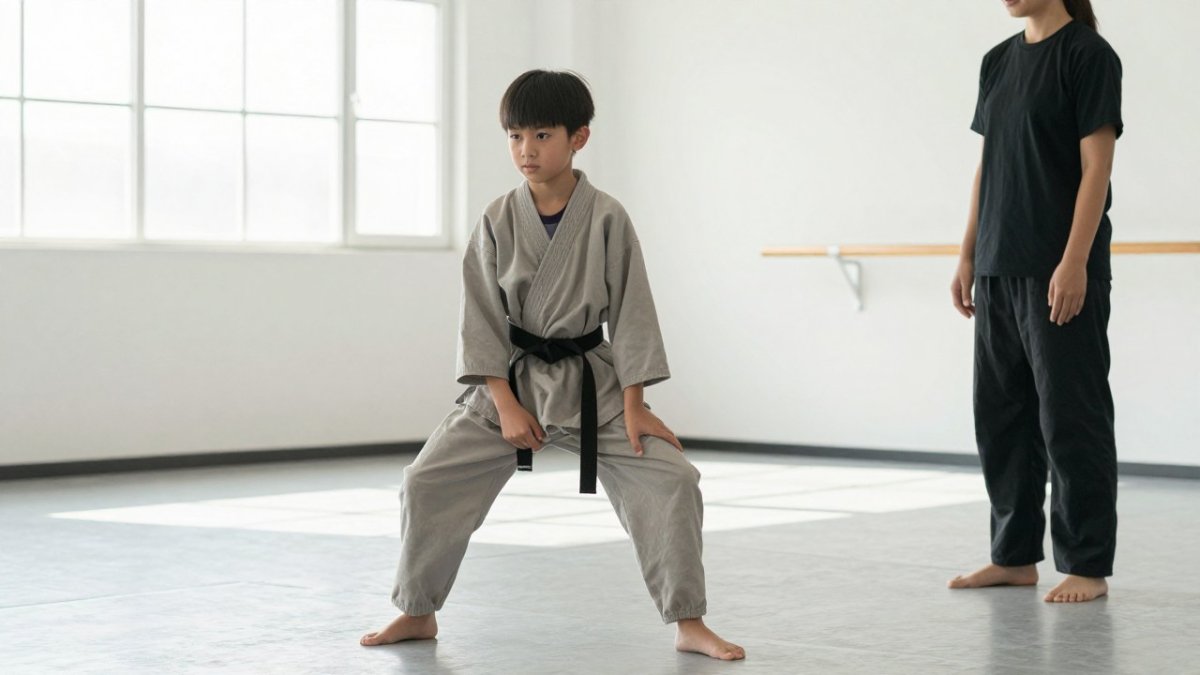
- Slow stance hold: Ages 5-7 hold a horse stance for 10 to 20 seconds; ages 8-10 for 20 to 40 seconds; ages 11 and up for 40 to 60 seconds. Rest twice as long as you hold.
- Form repetition: Practice one short form three to five times with a 30- to 60-second rest between sets. Younger students do three sets; older students can build to five.
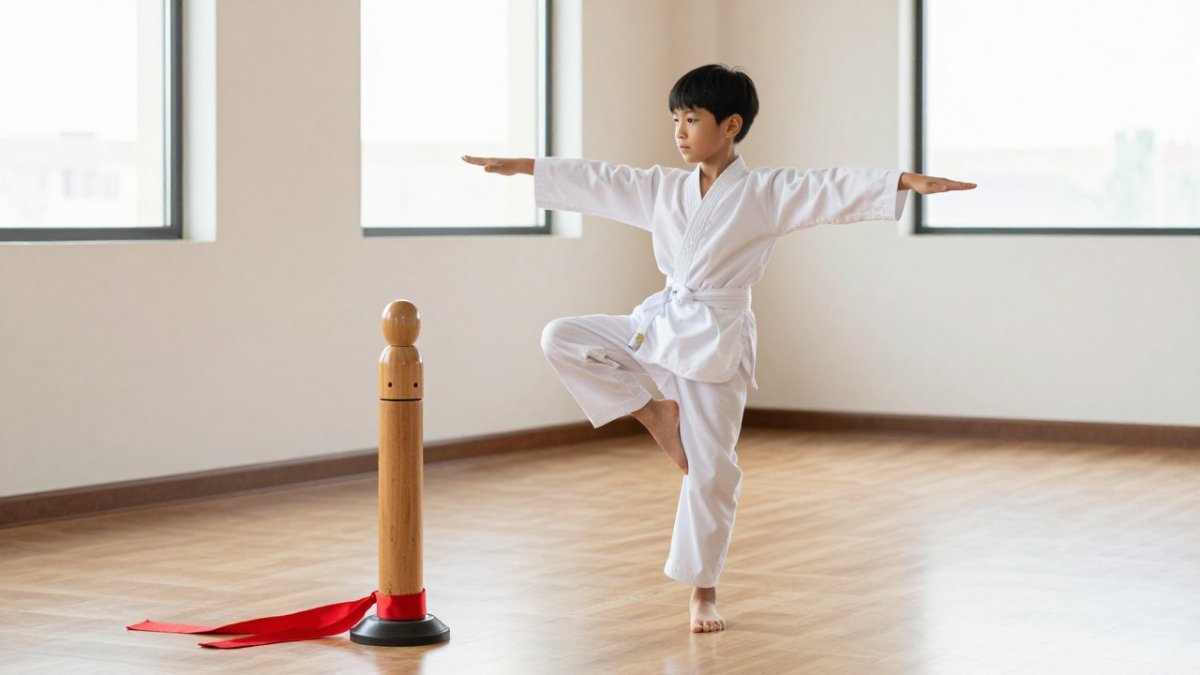
- Balance count: Stand on one leg while counting to 15 for younger children, 30 for older children, then switch sides. Let the child touch a wall with one fingertip if balance is still developing.
- Partner push-back: A partner applies light, slow pressure to a basic block for 5 to 10 seconds. The child's job is to keep breathing and hold structure, not to win.
- Calm reset: After each hard exercise, pause for one slow breath in and out. This teaches the child that recovery is part of the drill, not a sign of weakness.
Adapting for Different Ages, Fitness Levels and Experience
A child who is new to martial arts, recovering from an illness, or less active should start at the low end of every range and add time only after two comfortable sessions. A child with prior martial arts experience can start mid-range but should still complete the calm reset between sets. Children with mobility differences can perform seated versions of the breathing and counting drills, and standing balance work can be done with a chair nearby for support.
Watch out: Stop any exercise if a child reports sharp pain, dizziness, or numbness, and never use holding a stance until tears as a motivational tool. Perseverance training should build trust in the body, not fear of the instructor.
Simple Progress Markers for Parents
You do not need a clinical test to see progress. Keep a short log of three things: how many sessions the child completed, how long they held the stance or balance without breaking form, and how quickly they returned to practice after a frustrating day. If progress stalls for more than a month or the child dreads practice, reduce the difficulty and talk with the instructor.
Building a Martial Arts Practice Routine for Kids
A steady routine helps a child practice between classes. Short, regular sessions work better than long, rare ones.
A simple weekly routine might look like this:
- Attend one or two scheduled classes
- Practice a five-minute breathing exercise each day
- Review one form at home three times a week
- Rest at least one day between harder sessions
Parents can help by setting a consistent time and a quiet space. Praise effort, not just results. A child who practices with a positive attitude will keep improving over time.
Booking Your Child's or Your Own First Class at Dragon Claw Academy
Starting is the hardest step, so keep it simple. Step-by-step guidance on booking a trial class walks you through scheduling your first session.
We recommend arriving 10 minutes early, wearing comfortable clothes, and bringing water. Tell the instructor about any past injuries or health concerns before class begins. Pricing depends on the program and schedule, so please check our website or contact us for a current quote.
Ready to build focus, discipline, and resilience? Contact Dragon Claw Academy to schedule a first class and see how traditional Kung Fu can help your family grow stronger together.
Frequently Asked Questions
How can kung fu training help build resilience?
Kung fu builds resilience through repetition, structured challenge and steady exposure to discomfort. Students repeat stances and forms until they stop quitting when a movement feels hard, and they learn to breathe and reset under physical pressure. Results vary by student, and training works best alongside rest and sensible pacing.
What does resilience mean for children?
For children, resilience means bouncing back from frustration, mistakes or setbacks without giving up or melting down. It is a skill rather than a personality trait, which means it can be practiced. In kung fu classes, a child who struggles with a form can keep trying with coaching, learning that effort leads to improvement. Parents often notice the carryover at home, such as handling a lost game or a difficult homework problem with more composure.
Can martial arts help children improve focus and self-discipline?
Martial arts can support focus and self-discipline because classes require attention to instructions, sequences and posture for extended periods. Bowing in, following a set order and waiting for a turn all reinforce self-control. Families should view these as possible benefits rather than guaranteed outcomes. Consistent attendance and a structured environment tend to matter more than any single class.
How often should a child practice martial arts to build confidence?
Most children benefit from two to three classes per week, with short daily practice of stances or breathing at home if the family can manage it. Consistency matters more than intensity, because confidence grows from repeated small successes. Parents should watch for signs of overtraining, such as persistent fatigue, irritability or lost sleep, and adjust the schedule when those appear. Instructors can recommend a pace suited to each child's age and physical readiness.